Rethinking digital
morphology
Why I created HPF ONE
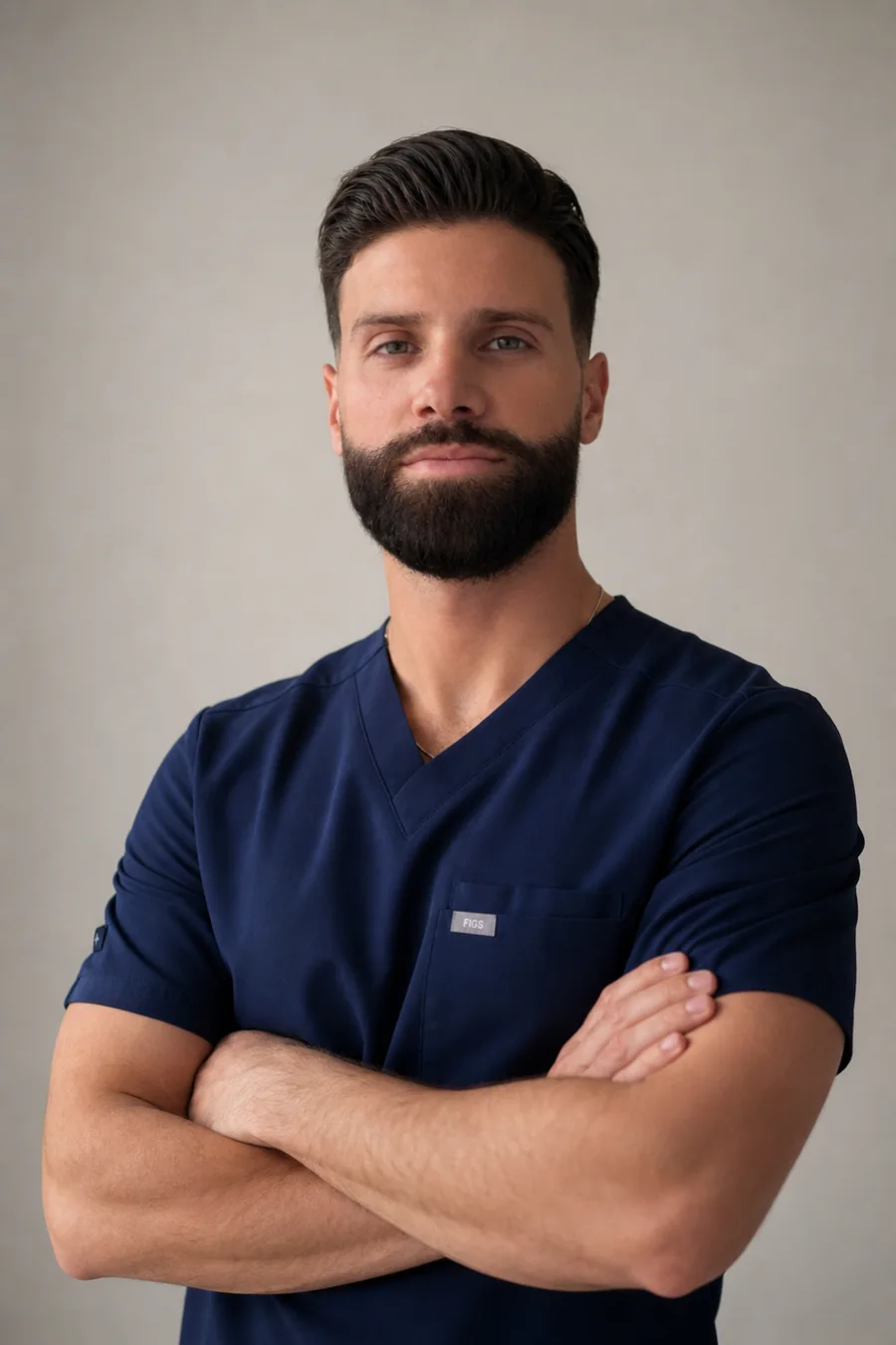
HPF ONE was born from a conviction: an exceptional restoration should never begin with a compromise.
For several years, in the laboratory and then alongside dozens of partner laboratories, I designed, observed and refined hundreds of restorations. Every case reinforced the same certainty: the quality of the final result depends profoundly on the shape chosen at the very first moment.
I would open an Exocad library, select a tooth, and then a long process of transformation would begin. Redefining volumes, reopening embrasures, refining transition lines, balancing emergence profiles, restoring a natural coherence to every surface.
Those corrections were part of my standards. But with experience, one realisation imposed itself: I wasn't only refining a restoration. Case after case, I was rebuilding the very base it had been created from.
Gradually, the same morphological principles emerged: the same balances, the same proportions, the same details. What remained was to turn them into a dental library: not a collection of shapes merely appealing when viewed in isolation, but a morphological system designed to take its place in a smile, to converse with the adjacent teeth, and to support the designer's work rather than constrain it.
HPF ONE was born from that ambition: to turn years of experience, corrections and morphological research into an immediately usable base.
What makes a tooth look natural
Naturalness comes from proportions, volumes and relationships. Not from the amount of detail.
Naturalness rarely comes from the tooth itself. It comes from its relationships. The eye does not judge an incisor in isolation: it reads how the incisal edge answers the lip, how the facial surface catches the light, how the tooth compares with its neighbour and its contralateral.
Nature does not work through perfect symmetry, but through balance: useful variation, discreet asymmetry, continuous transitions. A shape that is too regular, too smooth, too centred rings false, even when you couldn't say why.
It judges a relationship.
Then comes the most stubborn misconception: believing that good morphology is measured by the amount of detail. Perikymata and micro-relief impress on a render, under raking light. But texture is the final layer, not the foundation, and the spectacular does not always survive the move into the real world, once pressed, milled or printed.
We made the opposite choice: simplify without impoverishing. Keep the details that carry intent, discard those that serve only the demonstration. A legible morphology invites personalisation; an overloaded one has already decided everything.
How HPF ONE was built
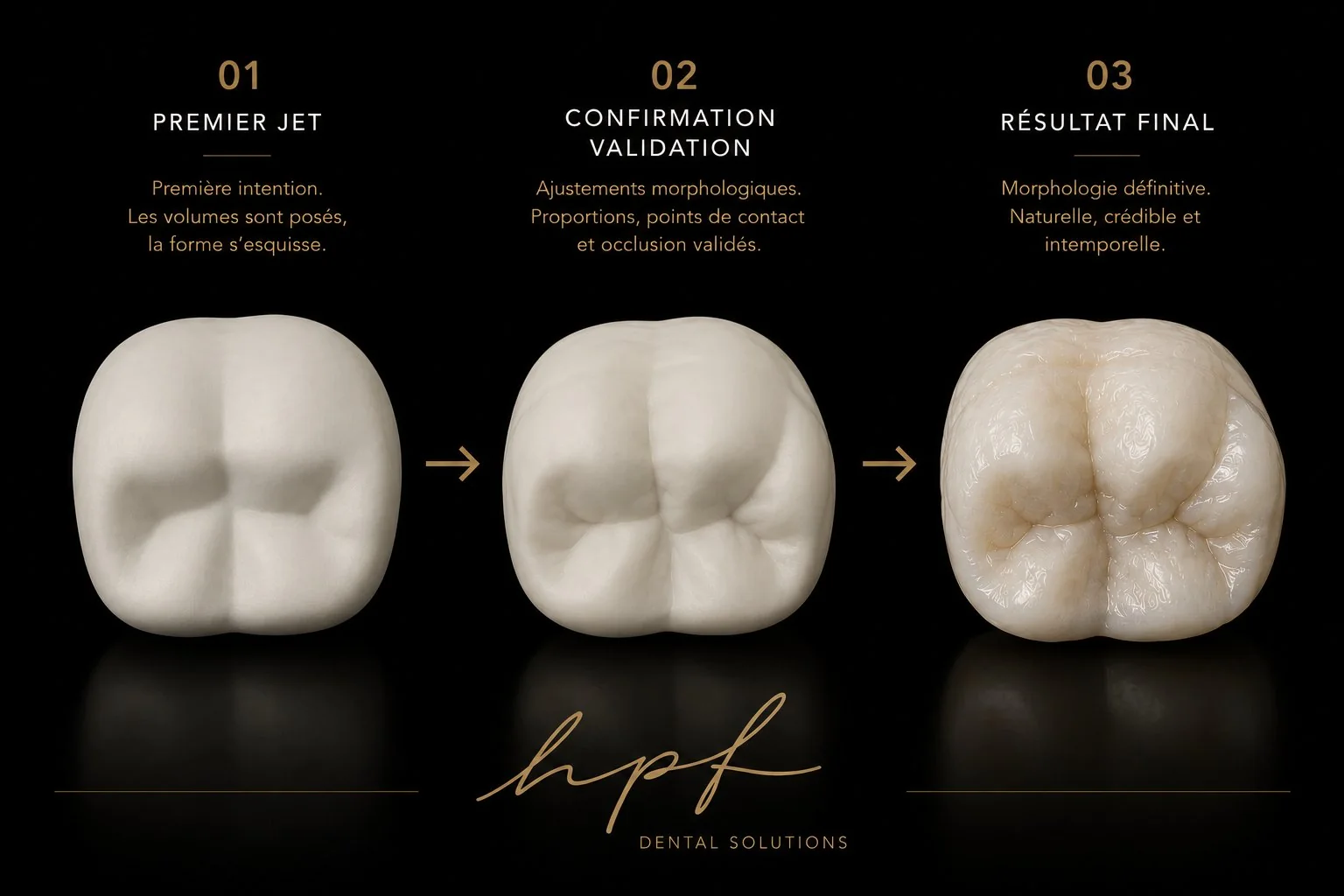
Morphology does not appear at once. It is built in stages, until there is nothing left to remove.
Every tooth in the collection followed the same path. A first pass, where the volumes are set and the shape takes form. A confirmation phase, where proportions, contact points and occlusion are adjusted and validated. Then the definitive version: natural and credible.
Between those stages, many shapes were never kept: too pronounced, too neutral, too beautiful on their own but impossible to integrate. Those back-and-forths, as much as the final result, define the identity of the collection.
Building a tooth as a volume
Creating a digital morphology does not mean drawing grooves, ridges or micro-relief straight away. As in sculpture, the work begins with a simple mass, whose proportions, orientation and main volumes are defined first.
In Exocad, a library tooth can serve as the starting point. It is then moved, stretched, compressed and remodelled until the shape is balanced and coherent with the arch and the neighbouring teeth.
The work thus progresses from the general to the particular. The method, step by step:
silhouette, volumes, transitions, function,
then details.
From aesthetics to clinical use
The morphologies were refined through the cases designed with the library, particularly on the proximal surfaces, the contacts and their occlusal integration. The aim was to offer a base that is not only aesthetic, but directly usable in a real workflow: more predictable contacts, fewer adjustments, a starting point that accounts for function as much as appearance.
A base to personalise
HPF ONE does not produce the same smile for every patient, and that is not its role. It gives you back the time spent rebuilding.
The collection installs into Exocad DentalCAD and appears among the available tooth libraries, ready to be called into a design. It fits the existing dental CAD/CAM workflow without changing its habits. The time saved on rebuilding goes where it matters: proportions, reading the face, the personality of the smile.
The freedom of the clinician and the designer remains intact. Realign an axis, reopen an embrasure, sharpen a character, soften an edge: the base yields to interpretation without resistance. Digital dental design begins where selection ends.
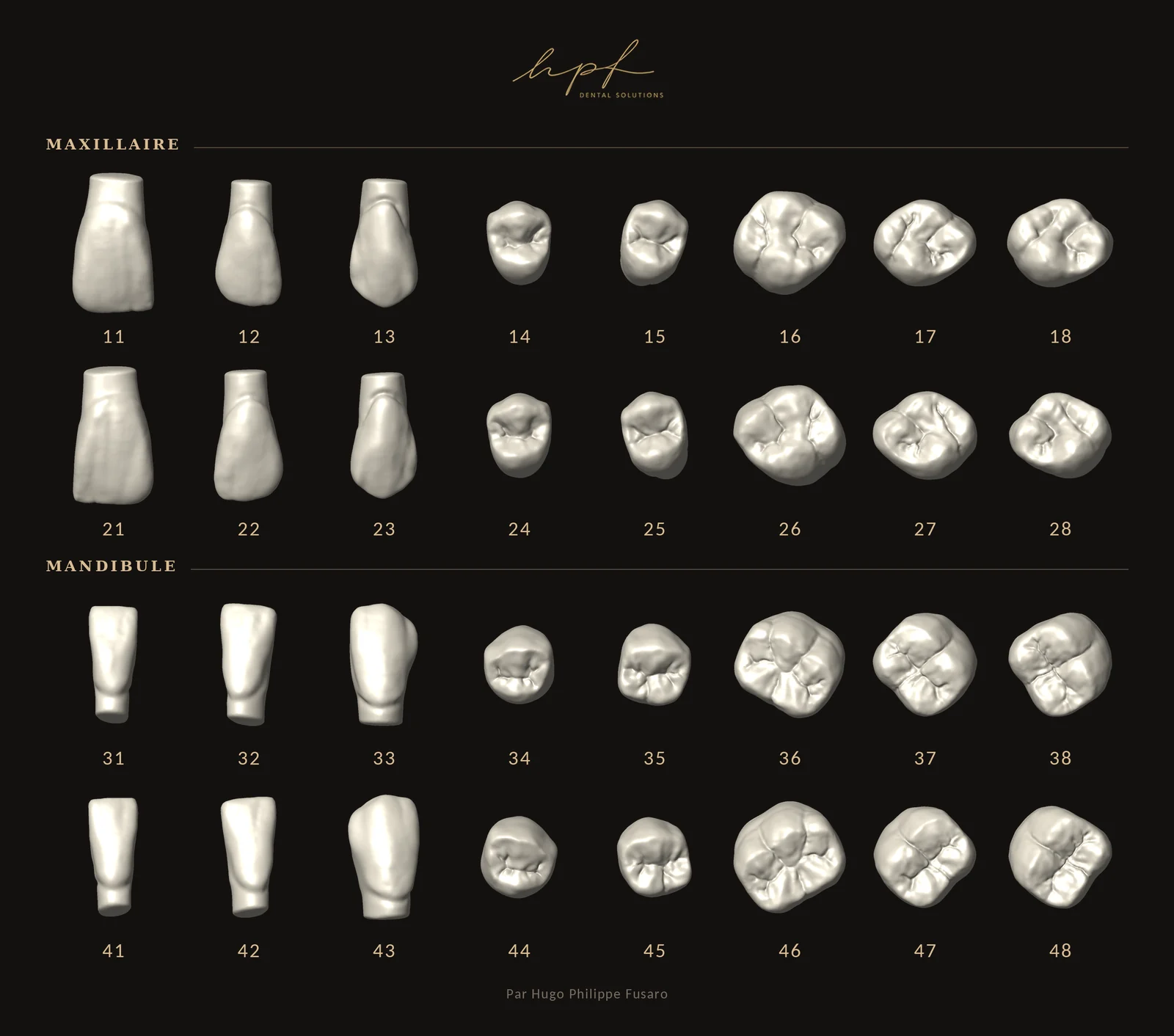
HPF Dental Solutions ONE · The Morphology Collection brings these principles together in a complete library of 32 morphologies, maxillary and mandibular, for Exocad. It was not designed to dictate a smile, but to offer the truest possible base for the one you are about to create.
Scientific references
The principles of morphology, proportion and perception presented in this article draw on major references from the literature in dental aesthetics, anatomy and prosthodontics.
- The principles of visual perception and their clinical application to denture esthetics. J Prosthet Dent. 1973;29(4):358-382.PMID: 4570911
- Dental esthetics and the golden proportion. J Prosthet Dent. 1978;40(3):244-252.DOI: 10.1016/0022-3913(78)90028-8
- Bonded Porcelain Restorations in the Anterior Dentition: A Biomimetic Approach. Quintessence Publishing; 2002.ISBN: 978-0-86715-422-1
- Esthetic Rehabilitation in Fixed Prosthodontics, Volume 1: Esthetic Analysis. Quintessence Publishing; 2004.ISBN: 978-1-85097-108-5
- Wheeler's Dental Anatomy, Physiology and Occlusion. 11th ed. Elsevier; 2020.ISBN: 978-0-323-63878-4
Editorial article for educational purposes. exocad and DentalCAD are trademarks of exocad GmbH. HPF Dental Solutions ONE is an independent product: neither affiliated with, approved by, nor sponsored by exocad GmbH. Final clinical validation of every restoration remains the responsibility of the professional.